Style Regions
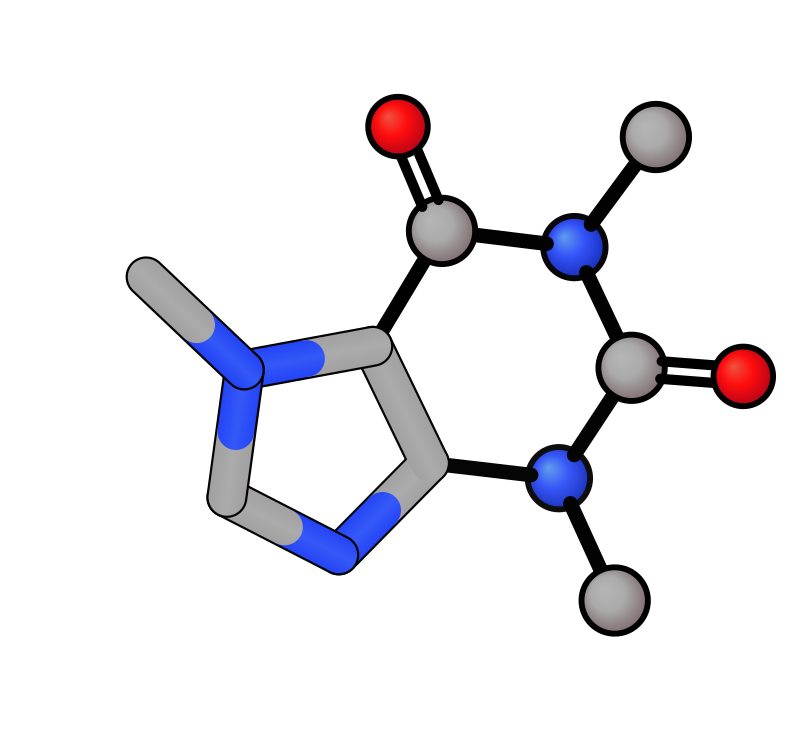
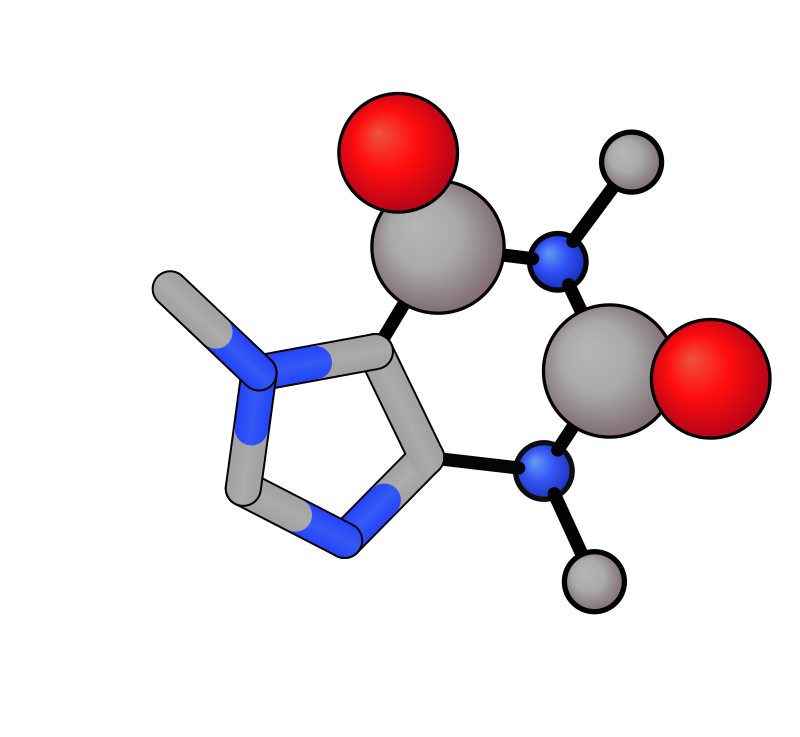
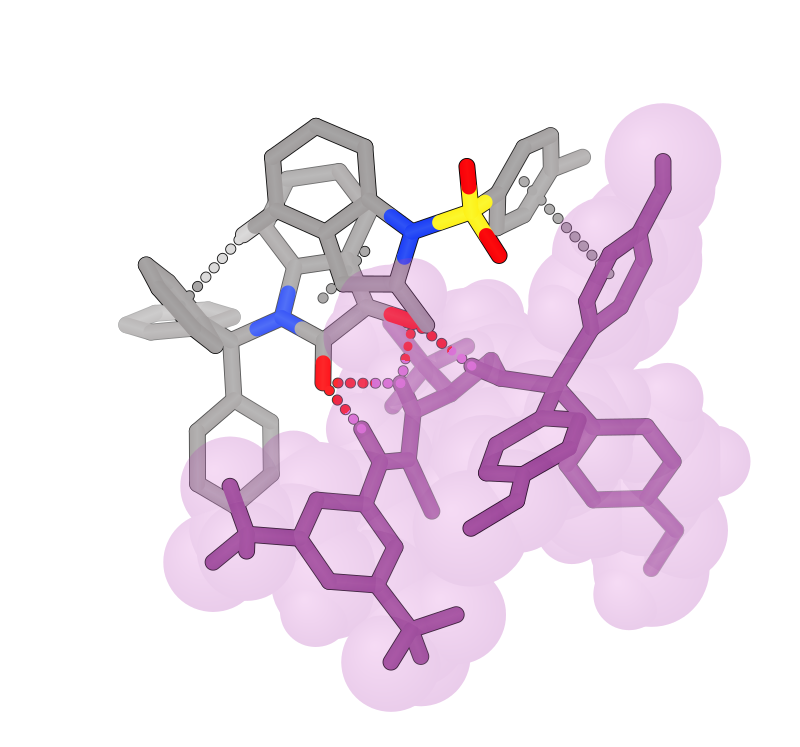
Render subsets of atoms with a different preset — useful for highlighting QM/MM regions, active sites, or multi-fragment systems. Each region specifies atom indices and a preset name (or JSON config path).
The base config controls global properties (canvas, fog, background). Regions override per-atom/bond properties (atom size, colors, bond width, gradient) for their atoms. Structural overlays (TS/NCI bonds, centroids) always use the base config.
Tube + ball-stick region |
Two regions |
Multi-fragment with NCI |
|---|---|---|
|
|
|
# Ball-stick base, tube for atoms 84–165
xyzrender mol.xyz --region "84-165" tube

# Tube base, ball-stick for the QM region
xyzrender mol.xyz --config tube --region "1-20" default

# Element selectors: all metals as ball-stick, rest as tube
xyzrender complex.xyz --config tube --region "M" default

# Specific element: Pt atoms as flat
xyzrender complex.xyz --region "Pt" flat

# Multiple regions with different presets
xyzrender mol.xyz --config tube --region "1-20" default --region "21-40" flat

# Multi-fragment: NCI detection + highlight + vdW + two regions
xyzrender bimp.xyz --no-orient --region "84-165" tube --nci --hl "84-165" --vdw "84-165"
From Python:
from xyzrender import load, render

mol = load("mol.xyz")

# Single region
render(mol, config="tube", regions=[("1-20", "default")])

# Element selectors (M = metals, Pt, sbm = s-block metals, het = heteroatoms)
render(mol, config="tube", regions=[("M", "default")])

# Multiple regions — indices are 1-indexed (strings or lists)
render(mol, config="tube", regions=[("1-20", "default"), ("21-40", "flat")])

# 1-indexed list form
render(mol, config="tube", regions=[([1, 2, 3, 4], "default")])
Preset-defined regions
Presets can define regions directly in JSON. The "regions" key maps atom selectors to a preset name or an inline overrides dict:
{
  "regions": {
    "M": "flat",
    "het": { "atom_scale": 4.0, "gradient": true }
  }
}
The built-in mtube preset uses this — metals are auto-highlighted via "regions": {"M": {...}}. Combine with --unbond pi to remove pi-coordination bonds on metal complexes:
mtube + unbond pi |
|---|
|
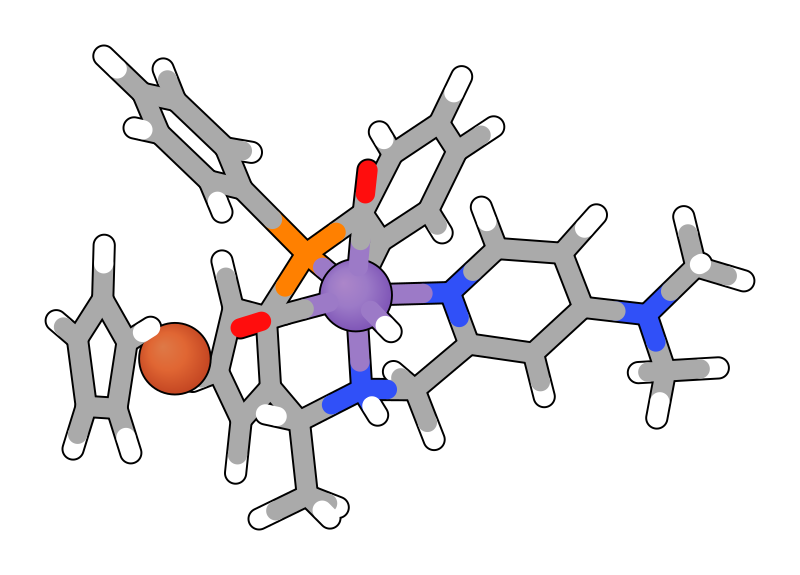
xyzrender mnh.xyz --config mtube --unbond pi
Combining with other overlays
Style regions compose with all existing overlays — highlight, vdW spheres, NCI detection, TS bonds, and annotations. This makes it easy to build up complex visualisations from simple flags.
# QM/MM: tube for the MM region, ball-stick QM region with highlight + vdW + NCI
xyzrender complex.xyz --region "84-165" tube --hl "84-165" steelblue --vdw "84-165" --nci

# Active site: wire background, highlighted residue with vdW spheres
xyzrender protein.xyz --config wire --region "1-30" default --hl "10-15" --vdw "10-15"
render(mol, config="wire",
       regions=[("84-165", "tube")],
       highlight=[("84-165", "steelblue")],
       vdw=list(range(84, 166)))
Highlight recolours atoms regardless of their region style, vdW spheres use the base config’s sphere settings, and NCI/TS bonds always render in the base style — so everything stays visually consistent even with multiple regions active.
Bond coloring
Element-coloured bonds and cylinder shading can be used with any preset.
xyzrender mol.xyz --bond-by-element                  # half-bond split by atom colour
xyzrender mol.xyz --bond-gradient                    # cylinder shading (3D tube look)
xyzrender mol.xyz --config tube --no-bond-by-element # uniform colour tube
render(mol, bond_color_by_element=True)  # half-bond element colouring
render(mol, bond_gradient=True)          # cylinder shading
The tube and wire presets enable both by default. The cylinder shading uses the same get_gradient_colors system as atom radial gradients — controlled by hue_shift_factor, light_shift_factor, and saturation_shift_factor in the preset JSON.
How two configs coexist
Each atom maps to either a region config or the base config via a per-atom lookup
Bonds between two atoms in the same region use that region’s bond style
Boundary bonds (one atom in region, one not) use the base config
TS/NCI bonds always use the base config — they are structural overlays, not molecular skeleton
NCI centroids (
*nodes) always use the base config
Flag |
Description |
|---|---|
|
Render atom subset with a different preset (repeatable). ATOMS selectors: |
|
Color bonds by endpoint atom colors |
|
Cylinder shading on bonds |