NCI Surface
Note
Surface plots are schematic 2D representations suitable for figures. For quantitative isosurface analysis, use a dedicated 3D viewer (VMD, PyMOL).
Visualise non-covalent interaction surfaces from a signed colouring field as the main input plus a second cube that defines the surface geometry.
--nci-surf now auto-classifies the surface cube as either:
low_field: points of interest are low, so the surface is extracted withdata < isohigh_field: points of interest are high, so the surface is extracted withdata > iso
This means the same flag works for both low-field analyses such as standard NCIPlot, and high-field analyses such as Multiwfn-style δg surfaces.
For standard NCIPlot output, use sign(λ₂)·ρ density as the main input and reduced density gradient as --nci-surf. These cubes are typically classified as low_field.
As an alternative analysis technique, Multiwfn-style δg surfaces use sl2r.cub as the main input and dg.cub, dg_inter.cub, or dg_intra.cub as --nci-surf. These cubes are typically classified as high_field.
Python. All
xyzrenderflags below map 1:1 to keyword arguments onrender(). The Python kwarg matching--nci-surfisnci=(path to the gradient/δg cube):render(load("dens.cube"), nci="grad.cube", iso=0.3, nci_mode="pixel"). See the Python API guide.
Note
The default --iso values are starting points, not universal thresholds. They reflect the original NCIPLOT (RDG = 0.3) and Multiwfn IGMH (δg = 0.005) literature conventions. In practice you will need to tune --iso per cube — especially for IGMH, where dg_intra cubes have a much larger value range than dg_inter and typically need --iso between 0.05 and 0.3 for clean surfaces.
The surface is rendered as individual flat-filled patches per interaction region. Coloring is based on the sign of λ₂ weighted by density: blue = strong attractive (H-bond), green = weak/vdW, red = repulsive (steric).
H-bond (base pair) |
π-stacking (phenol dimer) |
|---|---|
|
|
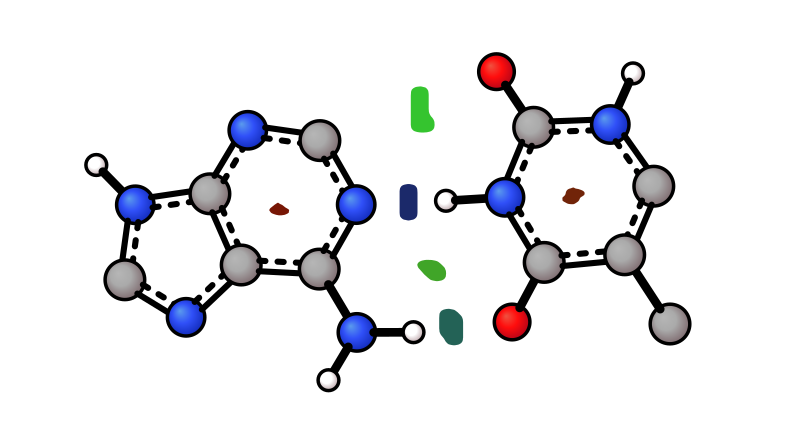
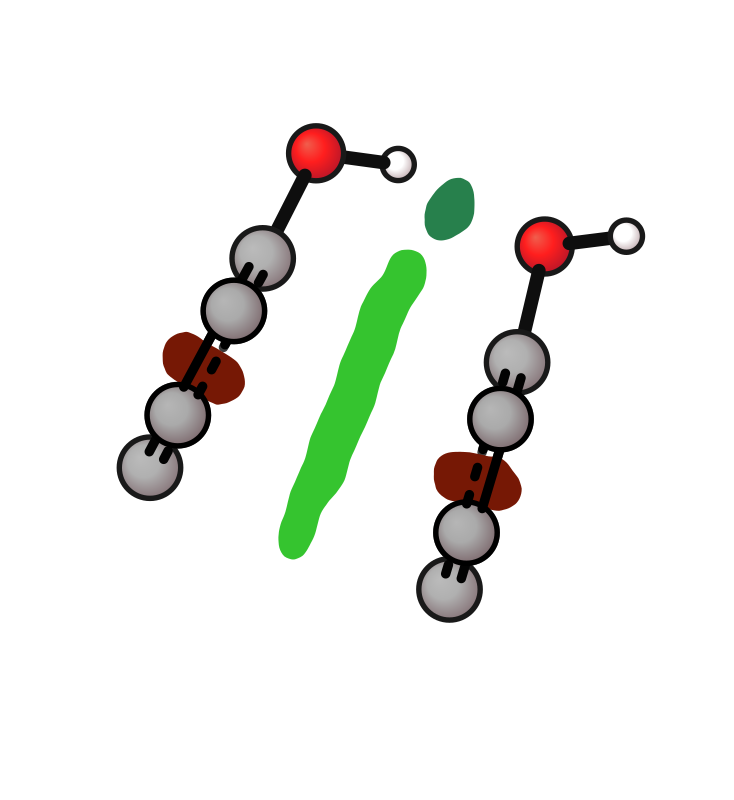
# avg coloring (default): blue=H-bond, green=vdW, red=steric
xyzrender base-pair-dens.cube --nci-surf base-pair-grad.cube -o base-pair-nci_surf.svg
xyzrender phenol_di-dens.cube --nci-surf phenol_di-grad.cube -o phenol_di-nci_surf.svg

# per-pixel (more detail)
xyzrender base-pair-dens.cube --nci-surf base-pair-grad.cube --nci-mode pixel

# flat color (default: forestgreen)
xyzrender base-pair-dens.cube --nci-surf base-pair-grad.cube --nci-mode uniform

# flat color with custom colour
xyzrender base-pair-dens.cube --nci-surf base-pair-grad.cube --nci-mode teal
As an alternative analysis technique, IGMH-style interaction surfaces can be similarly visualised using --nci-surf alongside an sl2r.cub colouring field. The examples below use phenol dimer dg_inter and dg_intra cubes to show intermolecular and intramolecular interactions separately.
IGMH Inter ( |
IGMH Intra ( |
|---|---|
|
|
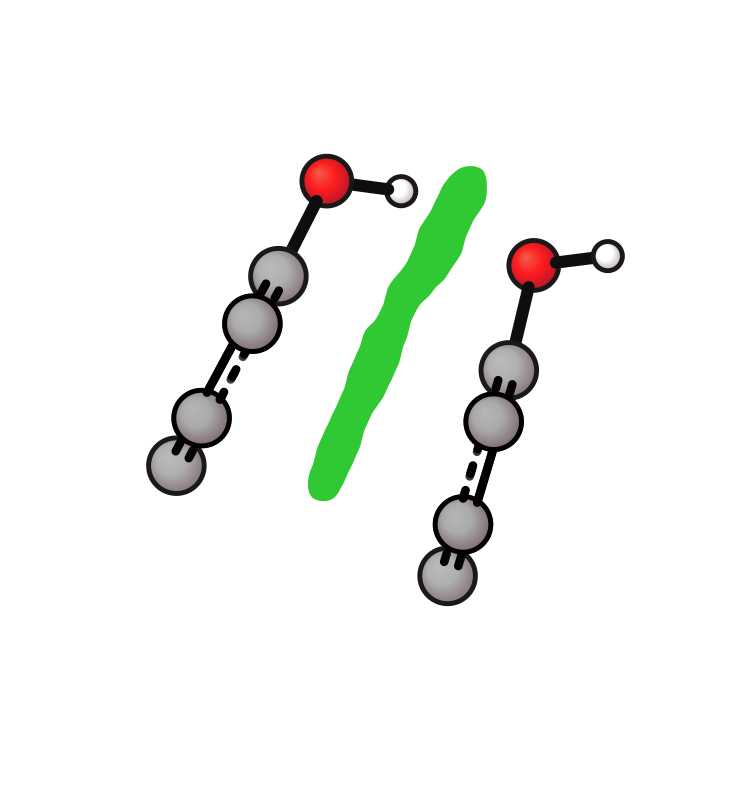
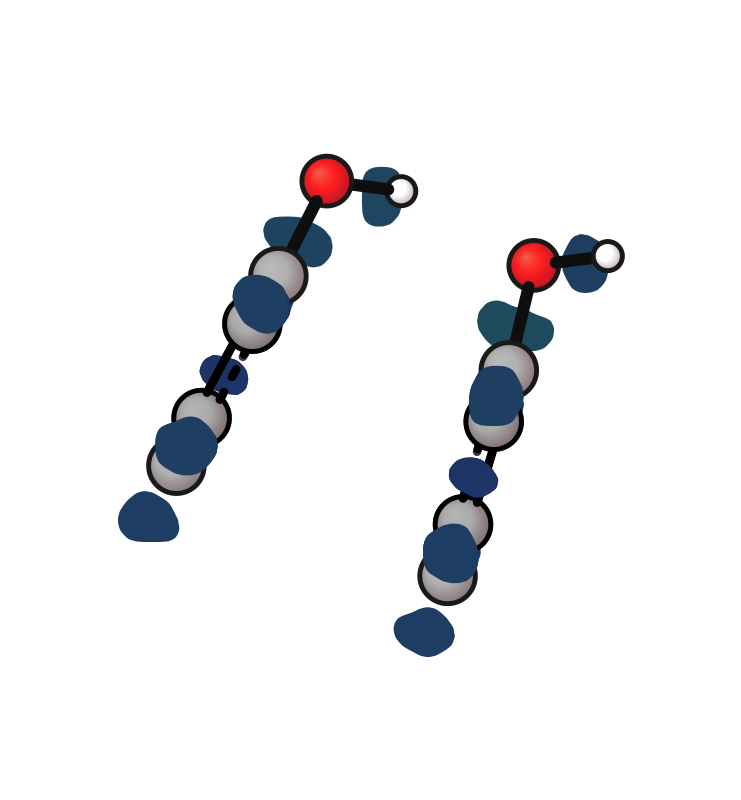
# intermolecular interaction surface
xyzrender phenol_di-sl2r.cub --nci-surf phenol_di-dg_inter.cub --iso 0.005 -o phenol_di_igmh_inter.svg

# intramolecular interaction surface
xyzrender phenol_di-sl2r.cub --nci-surf phenol_di-dg_intra.cub --iso 0.2 -o phenol_di_igmh_intra.svg
Coloring modes (--nci-mode):
Pixel (base pair) |
|---|
|
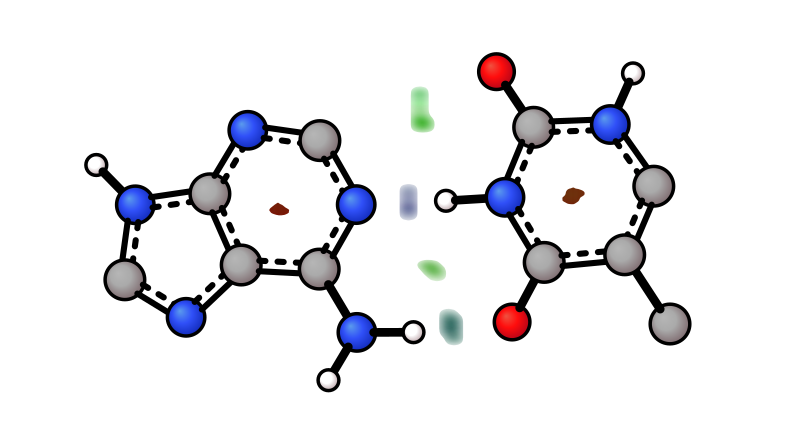
xyzrender base-pair-dens.cube --nci-surf base-pair-grad.cube --nci-mode pixel -o base-pair-nci_pixel.svg
Mode |
Description |
|---|---|
|
Each NCI lobe filled with its mean |
|
Per-pixel |
|
Flat single color for all NCI regions (default: |
colour |
Any colour name or hex — shorthand for uniform mode with that colour |
Surface styles also work on NCI patches:
Mesh |
|---|
|
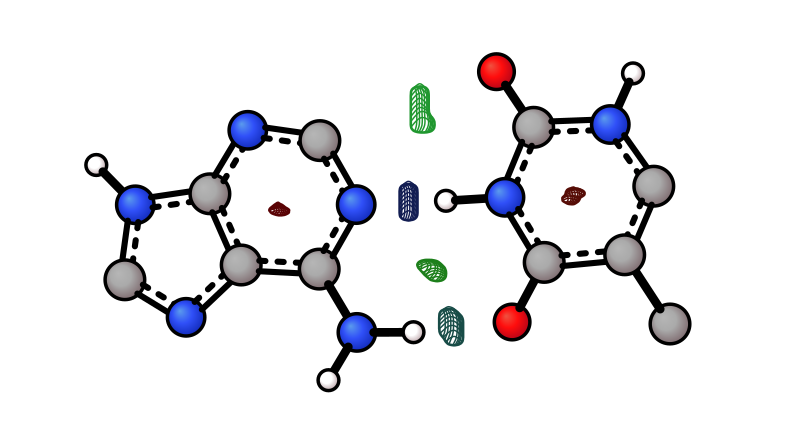
xyzrender base-pair-dens.cube --nci-surf base-pair-grad.cube --surface-style mesh
All interaction surface flags:
Flag |
Description |
|---|---|
|
Interaction surface cube file. Auto-classified as |
|
Coloring: |
|
Surface isovalue threshold (starting point — tune per cube). Low-field (NCIPLOT RDG) renders regions below the cutoff (default |
|
Surface opacity multiplier (default: 1.0) |
|
|
|
Density magnitude cutoff (advanced — not needed for standard NCIPLOT output) |
Sample structures from NCIPlot.