Transition States and NCI
xyzrender uses xyzgraph for molecular graph construction from Cartesian coordinates — determining bond connectivity, bond orders, detecting aromatic rings, and non-covalent interactions. It also provides element data (van der Waals radii, atomic numbers) used throughout rendering.
Transition state analysis uses graphRC for internal coordinate vibrational mode analysis. Given a QM output file (ORCA, Gaussian, etc.), graphRC identifies which bonds are forming or breaking at the transition state with --ts. These are rendered as dashed bonds. graphRC is also used to generate TS vibration frames for --gif-ts animations.
Python. Most
xyzrenderflags map 1:1 to keyword arguments onrender()/render_gif(). Two things to note here:--ts(and--nci-detect) areload()options —mol = load("sn2.out", ts_detect=True)— while manual overlay bonds are passed torender()orrender_gif()as 1-indexed tuples (ts_bonds=[(1, 2)]) rather than a"1-2"string. See the Python API guide for the load/render split.
Transition states
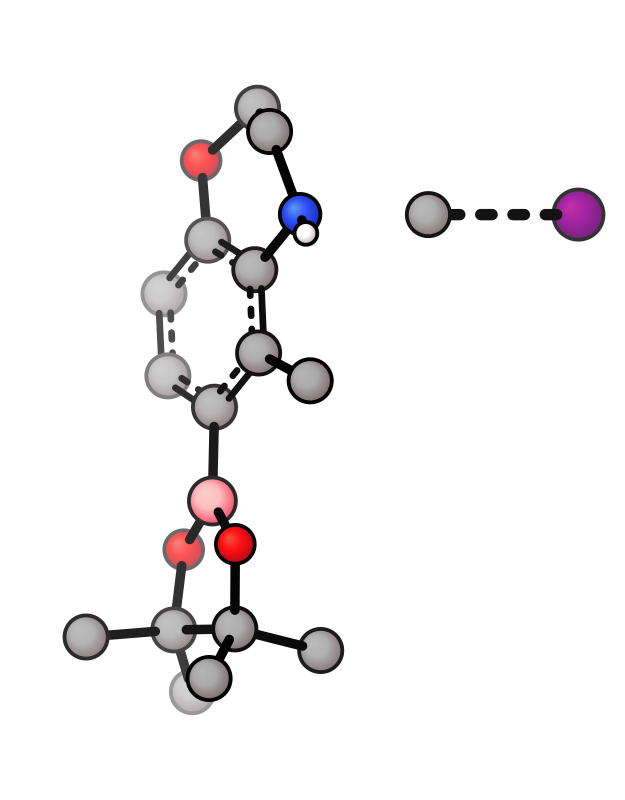
--ts auto-detects forming/breaking bonds from QM output. TS bonds are rendered as dashed lines.
Auto TS |
Manual TS bond |
|---|---|
|
|
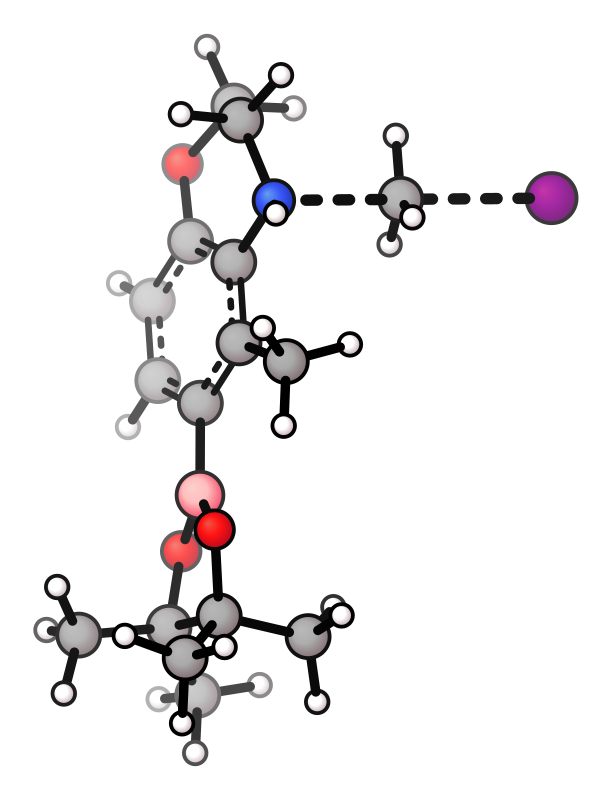
xyzrender sn2.out --ts --hy -o sn2_ts.svg
xyzrender sn2.out --ts-bond "1-2" -o sn2_ts_man.svg    # specific bond only
xyzrender sn2.out --ts --ts-color dodgerblue -o sn2_ts_blue.svg
mol = load("sn2.out", ts_detect=True)            # equivalent to --ts at load-time
render(mol, hy=True, output="sn2_ts.svg")

render("sn2.out", ts_bonds=[(1, 2)], output="sn2_ts_man.svg")  # 1-indexed tuple list
render("sn2.out", ts_bonds=[(1, 2), (3, 4)], ts_color="dodgerblue")
QM output files
ORCA output |
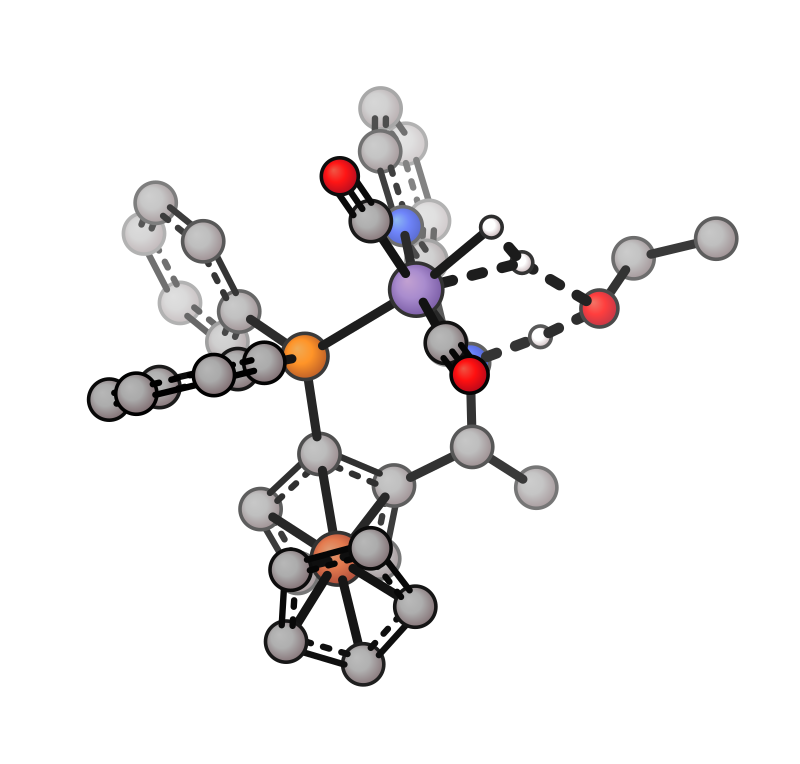
Gaussian TS |
|---|---|
|
|
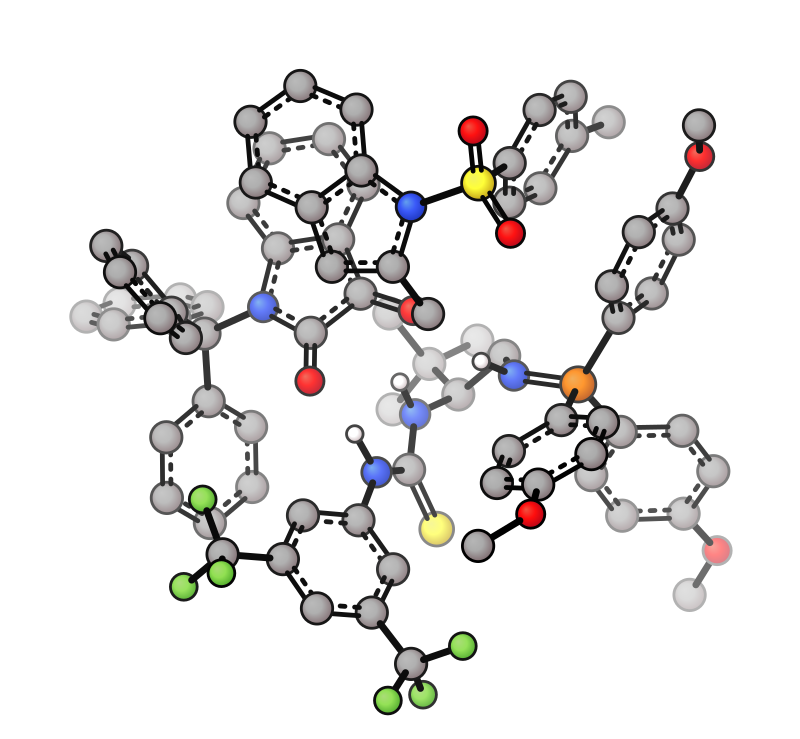
xyzrender bimp.out -o bimp_qm.svg
xyzrender mn-h2.log --ts -o mn-h2_qm.svg
NCI interactions (--nci)
--nci uses xyzgraph’s detect_ncis to identify hydrogen bonds, halogen bonds, pi-stacking, and other non-covalent interactions from geometry. These are rendered as dotted bonds.
For pi-system interactions (e.g. pi-stacking, cation-pi), centroid dummy nodes are placed at the mean position of the pi-system atoms. For trajectory GIFs with --nci, interactions are re-detected per frame.
Auto NCI |
Manual NCI bond |
|---|---|
|
|
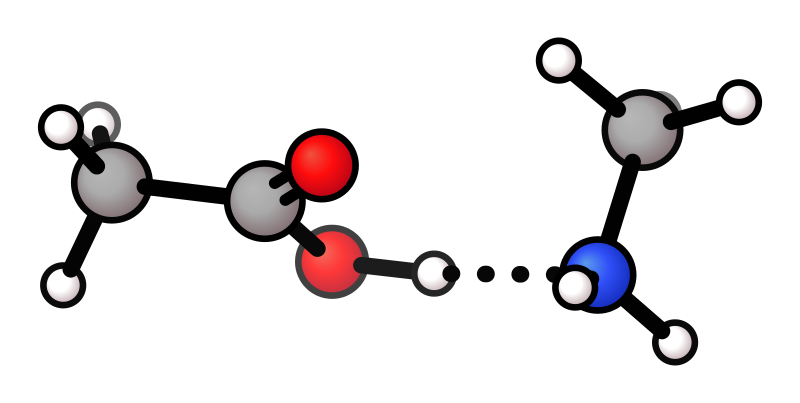
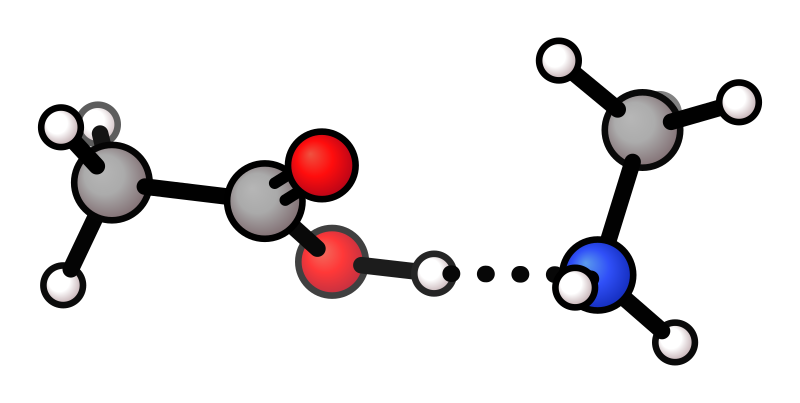
xyzrender Hbond.xyz --hy --nci -o nci.svg                 # auto-detect all NCI
xyzrender Hbond.xyz --hy --nci-bond "8-9" -o nci_man.svg  # specific bond only
xyzrender Hbond.xyz --hy --nci --nci-color teal -o nci_teal.svg
mol = load("Hbond.xyz", nci_detect=True)          # equivalent to --nci at load-time
render(mol, hy=True, output="nci.svg")

render("Hbond.xyz", nci_bonds=[(8, 9)], hy=True)  # 1-indexed tuple list
NCI + TS combined
Default colours |
Custom colours |
|---|---|
|
|
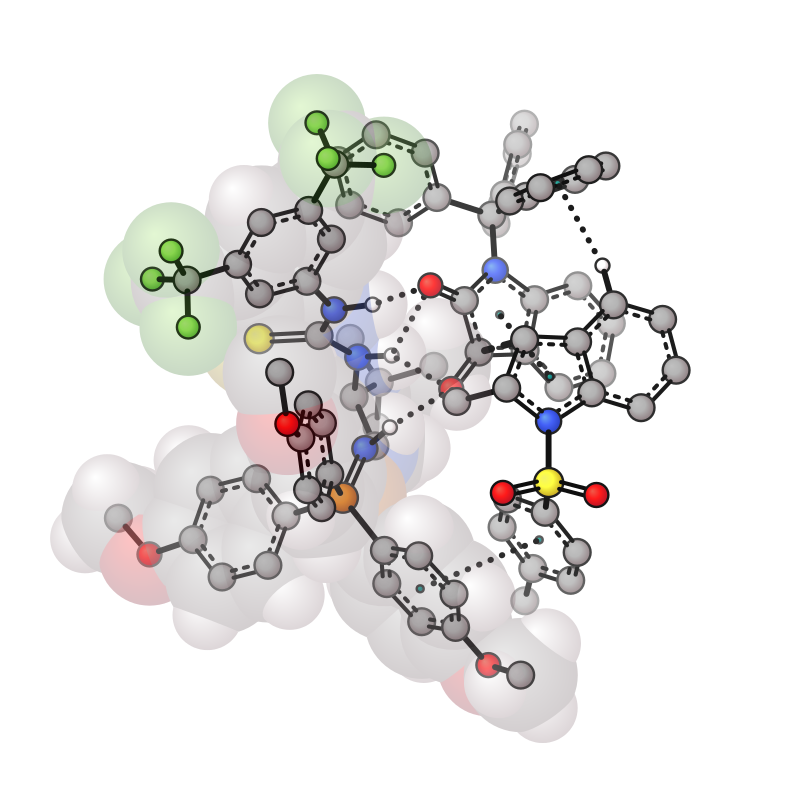
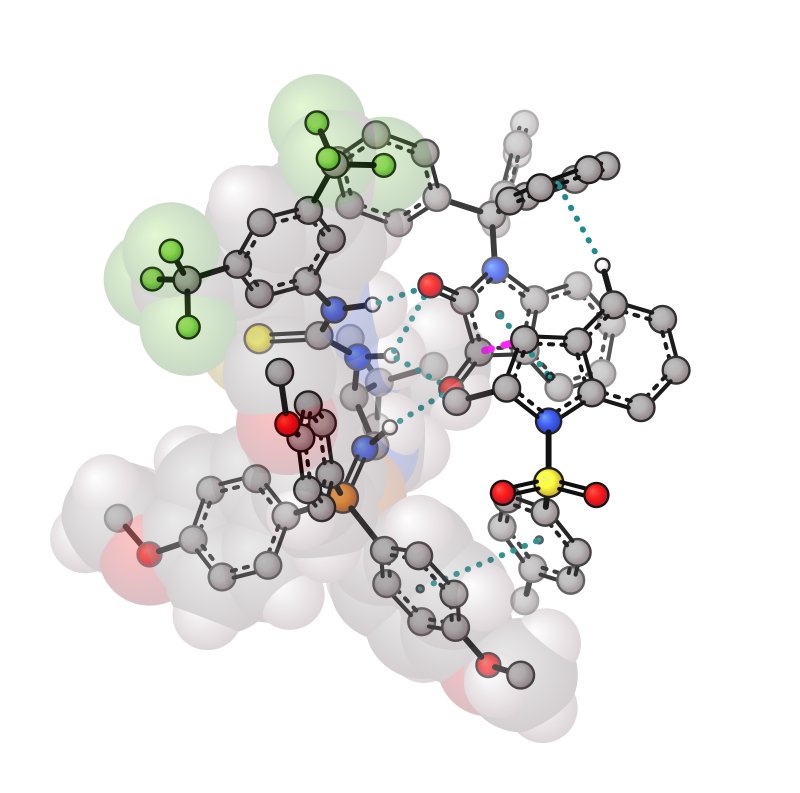
xyzrender bimp.out --ts --nci --vdw 84-169 -o bimp_ts_nci.svg
xyzrender bimp.out --ts --nci -vdw 84-169 --ts-color magenta --nci-color teal -o bimp_ts_nci_custom.svg
Styling controls
TS and NCI/haptic styling has three independent axes — colour, dash pattern, and line width — plus a TS/NCI categorisation. Haptic always follows NCI’s controls.
Colour
Two ways to set it:
Flat colour (
--ts-color/--nci-color) — single hex or named colour for every dash/dot.Atom-coloured halves (
--ts-element/--nci-element) — each dash/dot splits into two halves coloured by the endpoint atoms (the same gradient solid bonds use underbond_color_by_element). Off by default for TS; on by default for NCI inpmol/btube/tube/mtubepresets.
Resolution: --ts-color / --nci-color always wins; otherwise the element split applies when the toggle is on and the preset has bond_color_by_element=True; otherwise the bond falls back to the default bond colour.
xyzrender bimp.out --ts --nci --config pmol                       # NCI element split (preset default)
xyzrender bimp.out --ts --nci --config pmol --ts-element           # add TS element split
xyzrender bimp.out --ts --nci --config pmol --no-nci-element       # opt back out
xyzrender bimp.out --ts --nci --ts-color red --nci-color teal     # flat colours
Dash pattern (--ts-dash, --nci-dash)
LEN,GAP — both numbers are multiples of bond_width. Position 0 is the dash/dot length (drawn segment), position 1 is the gap (empty segment).
Default |
Visual |
|---|---|
|
medium dashes with a moderate gap |
|
long dashes, near-continuous |
|
short dashes / large gap (sparser) |
|
dots with even spacing (default) |
|
bigger dots, tighter spacing |
Python: accepts string "1.2,2.2" or tuple (1.2, 2.2). JSON: array [1.2, 2.2].
Line width (--ts-width, --nci-width)
MULT — line stroke width as a multiple of bond_width. Defaults: TS = 1.2 (slightly thicker than bonds), NCI = 1.0 (same as bonds).
xyzrender sn2.out --ts --config pmol --ts-width 0.5  # thinner TS dashes
xyzrender sn2.out --ts --config pmol --ts-width 2.0  # thicker, prominent
Dash length and line width are independent — changing --ts-width does not rescale --ts-dash.